If you’re like me, sometimes you’ll have a break in between projects, or you will be updating your portfolio and think “I’ve got a gap here I want to fill - I want to create more of ‘x’ type of illustration”, or “I really want to put that idea that has been in my head onto paper.”
Creating your own brief is a great way to add to your portfolio if you like the work you’ve made and it can also be a great way to experiment with different areas of illustration and styles! Don’t ever stop exploring within your own work.
Key elements to include in an illustration brief
They don’t have to be anything complex or in-depth, but I find that writing down a basic structure or even making some notes in bullet-point format can help you keep on track, and to a deadline if needs be as this is a good time to practice for when a tight client deadline comes around. Using a generator can be helpful hear too if you can’t decide on something.
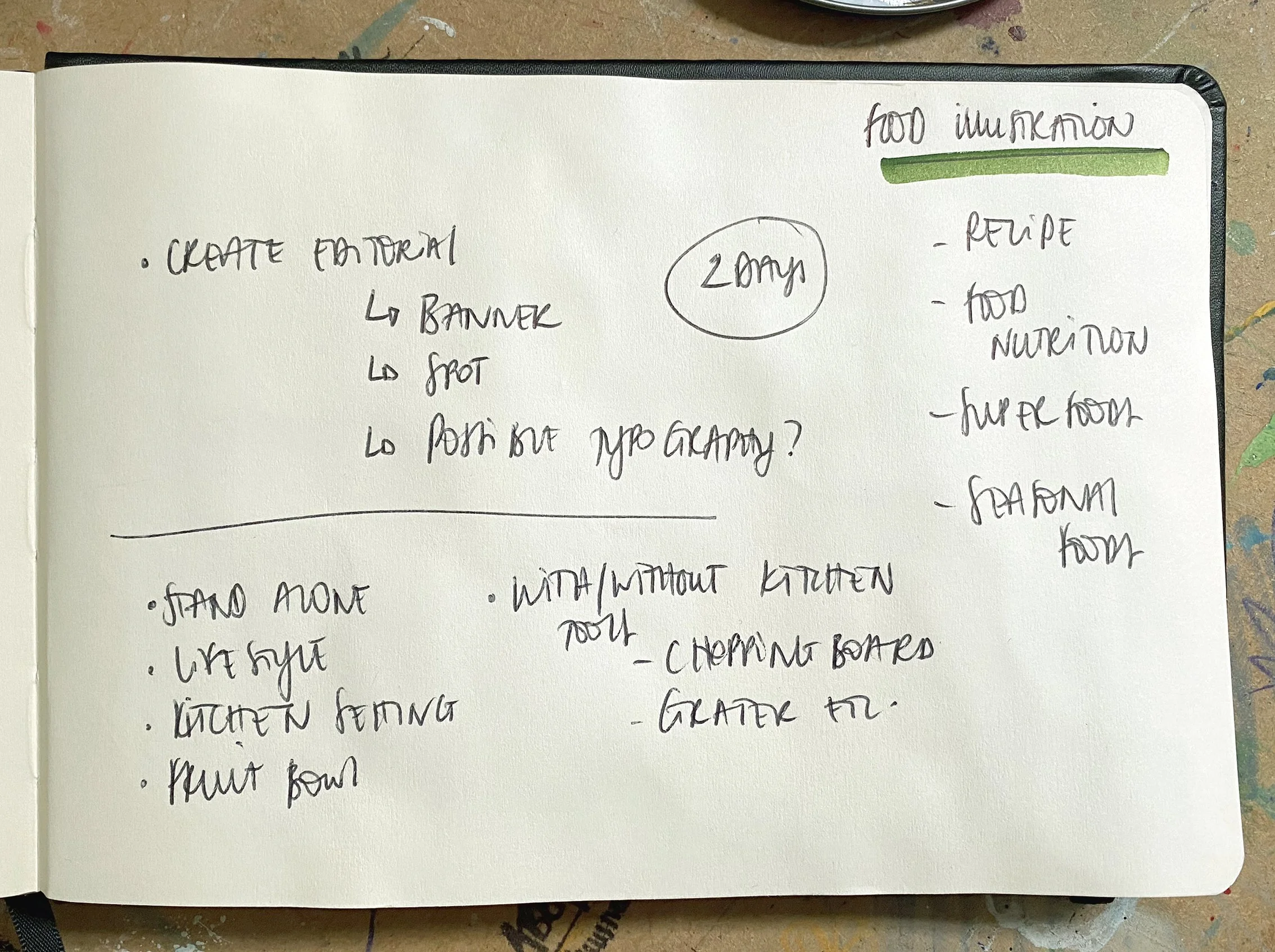
I make really scruffy notes in a sketchbook - remember this is just for you to use. No one else will see it (unless you blog about it and then put it on the internet!)
Let’s use an editorial as an example here. I often think that there are some lifestyle-type illustration gaps within my portfolio so to rectify that, and to get me used to drawing these type of illustrations, I typically search for some articles online from publications I enjoy and would like to work with.
Even better, head to a shop/bookshop/library where you can find magazines, books, published work that you can pick up, read and flick through. It is much easier to get a feel for the publication as a whole that way.
Ultimately an illustration brief typically (and should) include the following:
How many illustrations and needed and what size they need to be (if applicable)
Where they will sit - with text, on their own, as part of a pre-outlined design
Colour, black and white or line work
How much time there is for the project (editorials are often very quick, a week or so, but often days)
Budget (as you’re making your own you don’t need this part, but it is useful to know that it is needed for client briefs)
I always find this useful, so if a client does commission you to do something that isn’t necessarily in your portfolio, you aren’t worried about creating an illustration completely from scratch or from a subject you’re simply not used to drawing very much or at all.
How to outline the project through the brief
Again, using editorials as our example here, find an article in a Waitrose food magazine (other high-end grocery magazines are available…), then read the article and write a ‘mini brief’ for yourself to create an illustration or set of illustrations.
For example, it could be a large article spread over 2-3 pages, and you might want to create a couple of spots, or a header illustration and a spot, to accompany the article.
Give yourself a set time limit as well - especially for editorials, since they often come with tight turnaround times from art directors! See what you come up with; if it doesn’t work out or you’re not happy with what you have created, it’s only a self-created project! There are no wider consequences - absolutely no one has to ever know or see what you made, so don’t worry about not getting it right.
Get drawing once you’re happy with my self-initiated brief. Don’t worry if the outcome isn’t what you wanted or you’re not happy with what you’ve drawn. You can always try again, change it, or revise it later on.
Take time to analyse what you’ve created.
I find it’s always useful to go back after some time has passed and do a ‘mini review’ of the work I’ve made. Make notes, jot down things in a list, or get the Post-Its out. Ask yourself what was it about the illustrations you produced that you didn’t like? What did you like? And what do you think you could have done better or more effectively in the time you gave yourself?
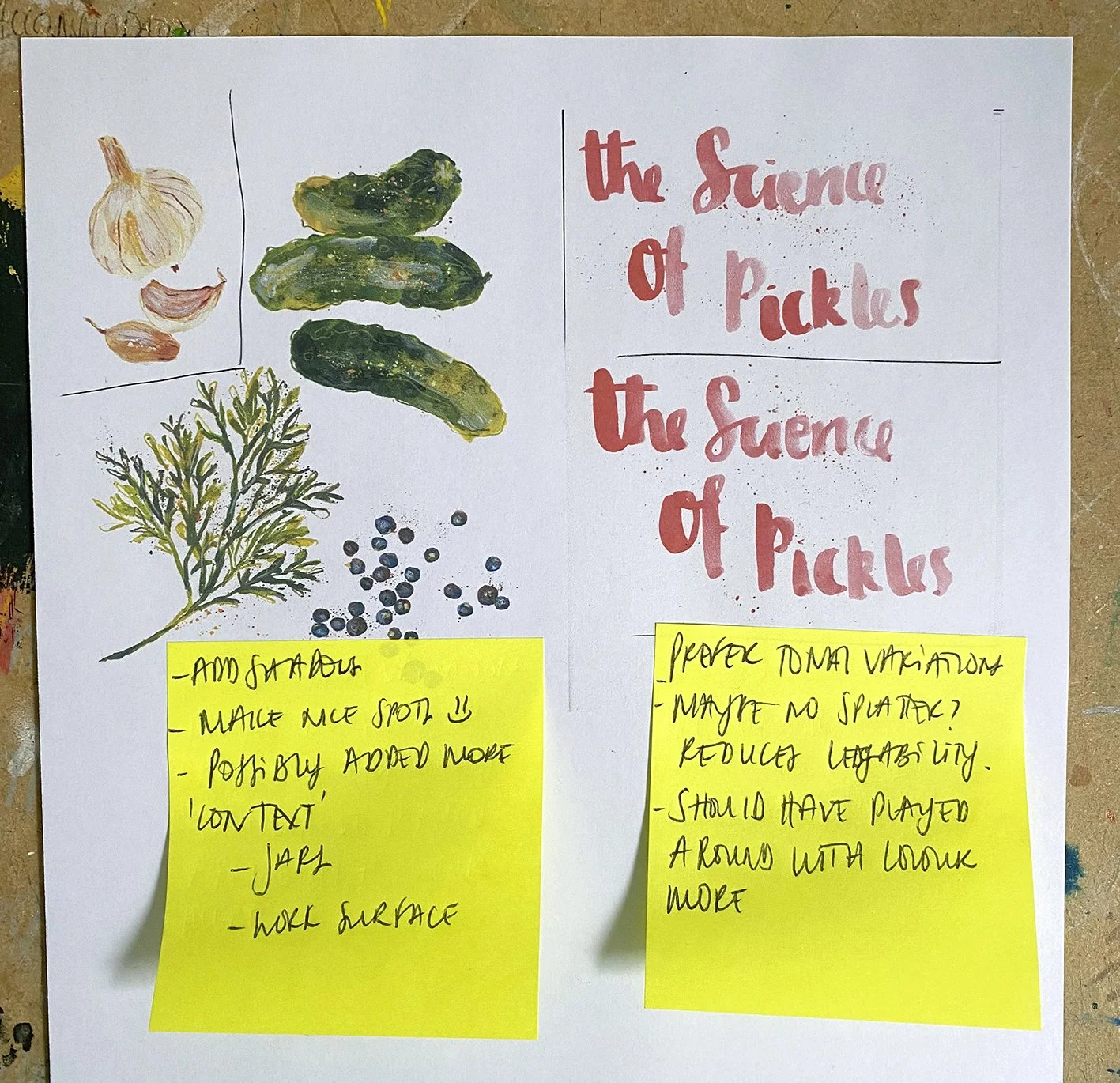
This isn’t fancy, and I really like to do this in an analogue way - you can use software or make notes digitally, but I like have a ‘hard-copy’. I often stick these into my sketchbooks so I’ve got a point of reference to come back to when I feel like it.
Each time you do a mini project, you will get better, quicker, and you’ll get used to producing illustrations ‘off-the-cuff’ or ‘on-the-fly’.
Ultimately, getting used to working to briefs will be a challenge if you’re not already familiar, but finding your own way of working with them, rather than against them, will only benefit you and your work in the long run.
Any questions - let me know in the comments, and if you have got any other killer tips, do share :)
Happy briefing!